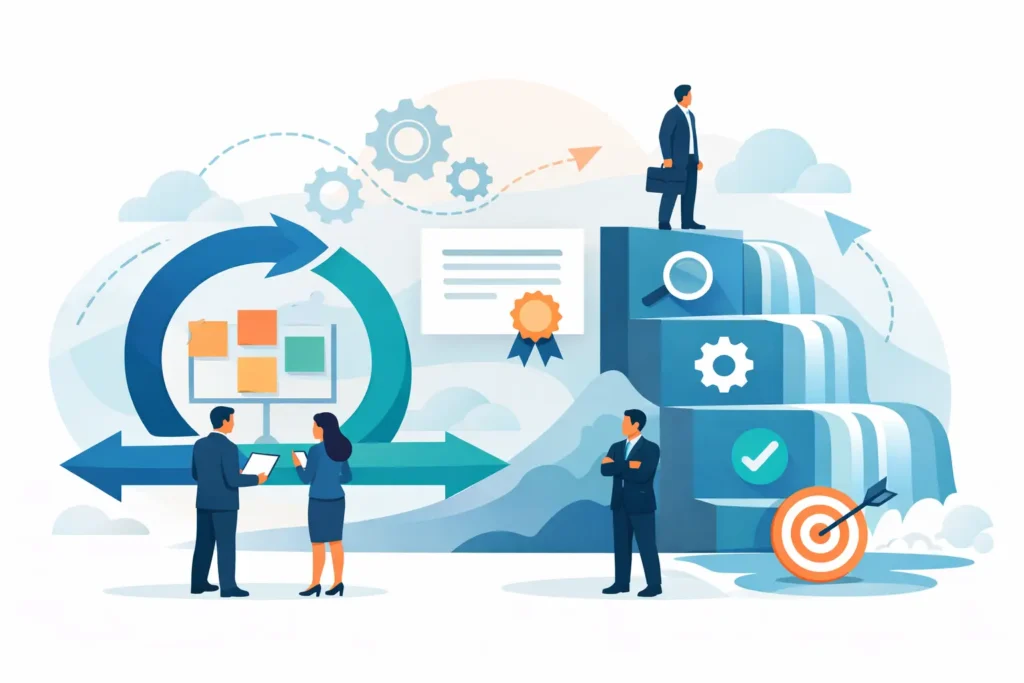
A construction schedule with fixed regulatory gates does not need the same delivery approach as a software product that changes after every customer release. Yet many project professionals work across both environments. That is why agile waterfall certifications are often searched as a single category: employers need leaders who can apply the right method to the work, rather than force every project into one framework.
The key distinction is that there is no widely recognized credential called an “Agile Waterfall Certification.” Instead, professionals typically choose a project management certification that validates predictive, agile, or hybrid delivery knowledge. The strongest choice depends on your experience, industry, target role, and the type of projects you expect to lead.
What Agile and Waterfall Credentials Actually Prove
Waterfall, often called predictive project management, organizes work through defined phases such as scope, design, execution, monitoring, and closeout. Requirements are established early, changes are controlled carefully, and progress is measured against a baseline plan. This approach remains central in construction, engineering, infrastructure, manufacturing, regulated industries, and many capital projects.
Agile delivery works differently. Teams plan in shorter cycles, receive frequent feedback, and adapt priorities as the product or business need develops. Scrum, Kanban, iterative planning, and continuous improvement are common practices. Agile is especially relevant to software, digital transformation, product development, and operations teams facing changing requirements.
A credible certification does not simply prove that you know the vocabulary. It signals that you can select an approach, plan work, manage stakeholders, control risk, and deliver measurable outcomes. For many employers, the most valuable professionals are those who understand both structured planning and adaptive delivery.
The Best Agile Waterfall Certifications by Career Goal
PMP for broad project leadership
The Project Management Professional, or PMP, is often the strongest option for experienced project managers who need a globally recognized credential across predictive, agile, and hybrid environments. Its value comes from breadth. It prepares professionals to lead projects using traditional planning where requirements are stable, agile practices where change is expected, and hybrid models where both are necessary.
For example, an engineering company may manage design approvals, procurement, safety requirements, and construction milestones predictively, while using short planning cycles to resolve site issues or coordinate technical changes. A PMP supports this type of leadership because it focuses on delivery principles, stakeholder engagement, planning, measurement, and business value rather than presenting one method as the answer to every project.
PMP is especially relevant for mid-career professionals, project engineers, construction managers, operations leaders, and professionals moving into senior project roles. It requires qualifying project management experience and formal training, so it is not generally the first certification for someone entering the field.
CAPM for early-career professionals
The Certified Associate in Project Management, or CAPM, is designed for professionals building a formal foundation in project management. It is a practical starting point for coordinators, junior engineers, planners, administrators, and professionals transitioning into project work.
CAPM covers predictive methods as well as agile and business analysis concepts. This makes it useful for learners who want to understand how projects are organized before specializing in a particular delivery model. It can also establish a stronger base for professionals planning to pursue PMP after gaining further experience.
PMI-ACP for agile delivery specialists
The PMI Agile Certified Practitioner, or PMI-ACP, is suited to professionals who already contribute to or lead agile teams. It addresses a range of agile approaches rather than concentrating only on one framework. That matters when an organization uses Scrum for product development, Kanban for support work, and iterative techniques for process improvement.
PMI-ACP can be a strong choice for software project managers, product-facing professionals, business analysts, agile team members, and transformation practitioners. It is most valuable when your day-to-day work requires active agile delivery, not merely familiarity with agile terminology.
For professionals in construction or large infrastructure projects, PMI-ACP may still add value, but it should be selected carefully. If your role centers on contracts, cost control, scheduling, compliance, and fixed milestones, a broad project leadership credential may produce a more direct career return.
Scheduling and project controls credentials for predictive work
Professionals working in major projects should not overlook technical project controls training. Primavera P6 and Microsoft Project training can strengthen capability in scheduling, resource planning, baseline management, progress tracking, and reporting. These are not substitutes for a project management certification, but they can be highly relevant where employers expect hands-on planning capability.
A project manager on a large construction program may benefit from PMP for leadership credibility and Primavera P6 for schedule control. The combination demonstrates both management judgment and operational competence. The right pathway is based on the responsibilities of the role you want next, not the popularity of a credential alone.
When a Hybrid Credential Is the Better Choice
Many organizations use hybrid delivery without labeling it that way. A project may begin with a formal charter, approved budget, fixed contract terms, and milestone schedule. Within that structure, teams may conduct weekly planning sessions, prioritize a backlog of issues, and adapt work based on stakeholder feedback.
This is common when the overall delivery commitment is fixed but parts of the work are uncertain. Consider a facility upgrade: regulatory approvals, procurement, and handover dates may follow a predictive plan, while technology configuration or user acceptance testing may need iterative cycles.
If this describes your work, a certification with broad predictive, agile, and hybrid coverage is usually more useful than a narrowly focused agile credential. PMP is frequently the practical choice for professionals responsible for the entire project lifecycle. PMI-ACP becomes more compelling when agile delivery is the primary operating model and you need deeper agile practitioner credibility.
How to Choose the Right Certification
Start with the roles you are pursuing over the next two to three years. If job descriptions emphasize project leadership, stakeholder management, budgets, schedules, governance, and cross-functional delivery, a broad credential is likely the right investment. If they emphasize sprints, product backlogs, team facilitation, release planning, and agile coaching, agile specialization may be more appropriate.
Next, assess your current experience. CAPM provides a structured entry point for professionals who do not yet meet advanced certification requirements. PMP is intended for experienced practitioners who can connect exam concepts to real project leadership. PMI-ACP is best approached with practical exposure to agile ways of working.
Then consider your industry. Predictive approaches remain essential in engineering, construction, energy, manufacturing, and regulated programs. Agile practices are often more dominant in software and product environments. However, industry alone should not decide the matter. A construction organization can use agile planning for design coordination, and a technology company can require formal predictive governance for vendor contracts and compliance.
Finally, look at the training format you can sustain. Working professionals need a plan that fits their schedule and prepares them for the actual exam. Instructor-led training, whether online or in a classroom, offers structure, accountability, practice questions, and direct access to an experienced trainer. A focused course schedule can be more effective than months of unstructured self-study, particularly when balancing project deadlines and family commitments.
Avoid Choosing a Certification by Trend
Agile credentials are valuable, but choosing one only because “agile” appears in job postings can create a mismatch between your credential and your responsibilities. The same is true for traditional project management credentials selected without considering whether you will use the knowledge.
Employers look for evidence that you can deliver work under real constraints: changing requirements, limited resources, stakeholder conflict, risk exposure, deadlines, and quality expectations. Your certification should support that story. Pair it with examples from your work, such as improving a schedule recovery plan, coordinating a cross-functional team, reducing rework, or managing changes without losing control of the baseline.
For professionals seeking structured, exam-focused preparation, MMTI offers instructor-led certification training designed around recognized project management pathways and flexible learning formats.
The best career move is not to choose between agile and waterfall as competing identities. Choose the credential that helps you lead the projects your employer has now and the projects you want to manage next.