
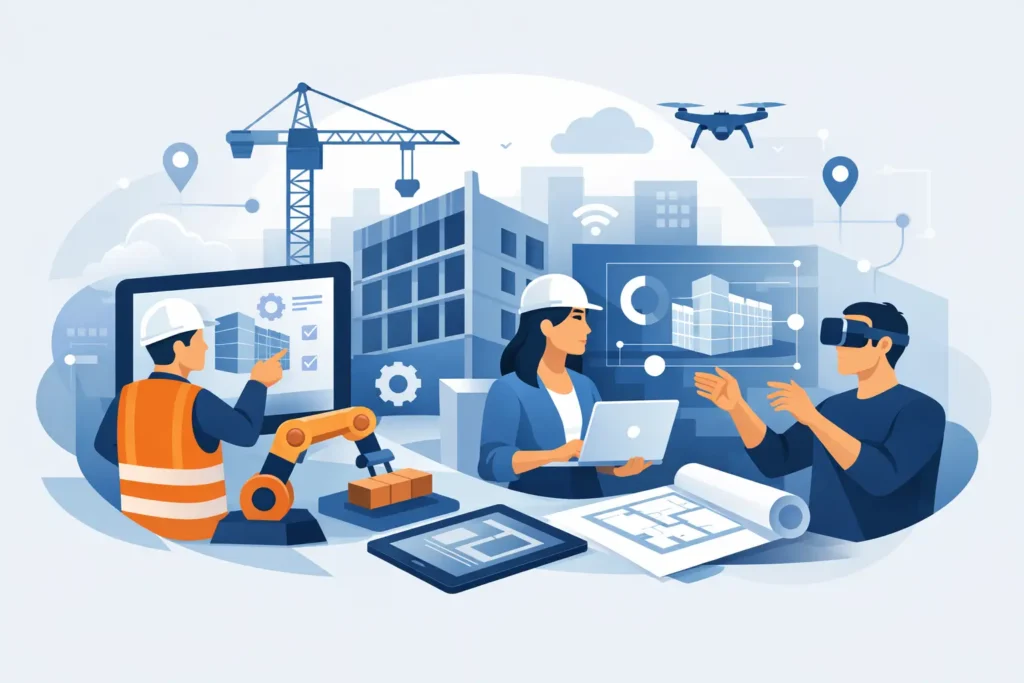
A project schedule can look controlled in Primavera P6 while the field team is working from an outdated model, a delayed drawing revision, or incomplete progress data. That gap is where many digital construction skills trends are becoming career-critical. Construction organizations do not need professionals who simply know how to open software. They need people who can turn digital information into clearer decisions, reliable controls, and predictable project outcomes.
For project engineers, planners, cost professionals, site leaders, and project managers, the opportunity is significant. Digital capability is increasingly part of how employers assess readiness for larger projects and leadership responsibilities. The strongest candidates combine construction knowledge, project management discipline, and practical command of the systems that connect design, planning, delivery, and handover.
Why digital construction skills now affect project careers
Digital construction is not one tool or one job title. It is the coordinated use of models, schedules, field data, document controls, cost information, and reporting to manage the project lifecycle. A building information model may support design coordination, but its value rises when the team uses it to sequence work, identify risks, verify quantities, and communicate progress.
This changes the standard for project professionals. A planner who understands critical path logic but cannot assess the quality of field progress data may struggle to produce a dependable forecast. A project manager who receives dashboards but does not question the source, timing, and definitions behind the metrics can make poor decisions quickly.
The trend is not that every construction professional must become a software specialist. The trend is that more roles require digital fluency, sound judgment, and the ability to work across disciplines. The exact skill mix depends on whether you work in planning, project controls, engineering, commercial management, or site delivery.
The digital construction skills trends employers value
Model-based coordination and BIM literacy
BIM literacy is moving beyond the design office. Project teams increasingly expect construction professionals to understand how models support coordination, clash resolution, quantity review, constructability discussions, and sequencing.
You do not need to be the person building every model to add value. You do need to know what a model can and cannot tell you. For example, a clash report may identify conflicts between systems, but it does not automatically establish responsibility, site access constraints, procurement impacts, or the most practical installation sequence.
Professionals who can translate model information into action are valuable because they reduce the gap between technical coordination and project execution. This is especially relevant for complex building, infrastructure, industrial, and MEP projects where late changes can affect cost, schedule, quality, and safety at the same time.
4D planning and schedule integration
The connection between a 3D model and a time-based schedule, often called 4D planning, is gaining practical relevance. It gives teams a visual way to test construction sequences, review work zones, plan temporary works, and communicate milestones to stakeholders who may not read a detailed schedule comfortably.
The technology alone does not produce a better plan. A weak baseline schedule connected to a polished model is still a weak plan. Strong 4D practitioners understand activity logic, calendars, constraints, resource assumptions, and critical path analysis before they create visual simulations.
This is why Primavera P6 and MS Project skills remain highly relevant. Professionals who can build, update, analyze, and explain a defensible schedule are better positioned to use advanced visualization tools effectively. The core project controls discipline comes first; digital presentation makes that discipline more usable.
Common data environments and document control
Construction teams generate a constant flow of drawings, requests for information, specifications, submittals, inspection records, meeting minutes, and change notices. A common data environment creates a controlled location for managing that information, its revisions, approvals, and distribution.
The skill employers value is not merely uploading files. It is understanding document status, approval workflows, revision control, naming conventions, access permissions, and the contractual consequences of using the wrong information. One outdated drawing can create rework that no dashboard can reverse.
Project professionals should be comfortable asking direct questions: Is this the latest approved revision? Who owns the action? What is the response deadline? Has the change been reflected in the schedule, cost report, and site instructions? These habits are digital construction skills because they protect data integrity and decision quality.
Data-driven project controls
Construction has always produced data. The difference now is the speed at which teams can collect, visualize, and distribute it. Dashboards may combine schedule progress, earned value, productivity, procurement status, cash flow, quality observations, and risk exposure in one place.
That can improve management visibility, but it also creates a risk: teams can mistake colorful reporting for accurate controls. A dashboard is only as useful as its underlying data, update cycle, and definitions. Percent complete can be misleading if it is not tied to measurable quantities, quality acceptance, or actual installed work.
Professionals should build confidence in data interpretation. They need to recognize trends, compare planned and actual performance, investigate variances, and identify the corrective actions that matter. This requires analytical skill as much as technical skill. A project leader must be able to explain why a variance occurred, what it means for the forecast, and who must act next.
Field technology and real-time reporting
Mobile applications, digital inspection forms, reality capture, drones, wearable devices, and connected equipment are making field reporting faster and more visible. Site teams can record observations, photos, checklists, quantities, and safety issues without waiting for a separate reporting cycle.
The trade-off is adoption. A field system will fail if it adds administrative burden without helping supervisors solve daily problems. The best implementation starts with a specific operational need, such as faster inspection closeout, clearer punch-list ownership, or more reliable labor productivity reporting.
For construction professionals, the skill is knowing how to structure information so that it can be used. Clear location coding, consistent work breakdown structures, practical forms, and timely verification matter more than collecting every possible data point. Better data starts with a process that the field can realistically follow.
Digital risk, quality, and change management
As information becomes more connected, risk management must become more disciplined. A design change can affect quantities, procurement, schedule logic, subcontractor scope, commissioning, and cost. Digital systems make those connections easier to trace, but only when teams apply formal controls.
This is where established project management capabilities remain essential. Risk identification, change control, stakeholder communication, quality planning, and lessons learned are not replaced by technology. They become more visible and more measurable through technology.
Credentials such as PMP, PMI-CP, PMI-RMP, and PMI-ACP can strengthen this foundation because they formalize the methods behind project decisions. Software knowledge helps a professional operate a platform. Certification-focused project management training helps them govern the work, defend the decision, and lead the response when conditions change.
How to build a credible digital construction skill set
Start with the role you want to perform, not with a random software list. A planning professional should prioritize schedule development, progress measurement, reporting, and 4D coordination. A project engineer may need stronger BIM coordination, document controls, submittal workflows, and change management. A cost or commercial professional may focus on quantity information, cost reporting, forecasting, and variation control.
Then build skills in layers. First, strengthen project management fundamentals and construction process knowledge. Next, gain working proficiency in the digital systems used by your organization or target employers. Finally, practice applying both areas to realistic project scenarios, such as recovering a delayed work package, reviewing a change impact, or validating progress for a monthly report.
Training should be structured and outcome-focused. An instructor-led Primavera P6 course, for example, is more valuable when it teaches baseline development, updating, delay analysis concepts, and reporting discipline rather than isolated menu commands. The same principle applies to BIM and field platforms: focus on the project decision the tool supports.
For working professionals, flexible classroom, online, evening, or weekend formats can make skill development realistic without interrupting project responsibilities. MMTI supports this approach by pairing recognized project management and planning credentials with practical, expert-led training designed for career progression.
Build judgment alongside technical proficiency
Digital construction will continue to change job descriptions, but it will not reduce the need for accountable project professionals. Teams still need people who can validate information, challenge assumptions, coordinate stakeholders, and make decisions under pressure.
Choose one digital capability that aligns with your next role, then connect it to a recognized project management discipline. That combination gives your training a clear purpose: not just operating the technology, but using it to deliver better-controlled construction projects.