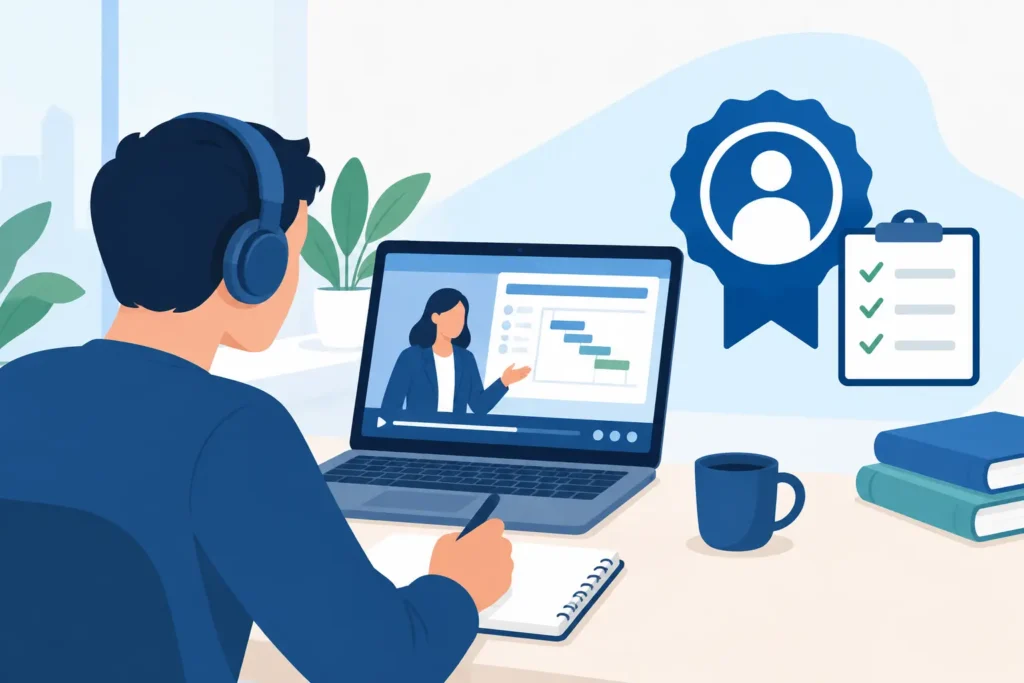
A project engineer who completes an online PMP course may be ready to submit an application, but the course itself is not the entire qualification. The question, “does online PMP qualify,” has two parts: whether the training meets PMI’s education requirement and whether the candidate meets the required project management experience.
For busy professionals, online PMP training can be a valid and practical path. The key is choosing a program that is structured around PMI eligibility requirements, documents your completion properly, and prepares you for the actual PMP exam. An online course can satisfy the training component. It cannot replace the professional experience PMI requires.
Does Online PMP Qualify for PMI Eligibility?
Yes, online PMP training can qualify toward the PMP application’s project management education requirement when it meets PMI’s current criteria. PMI generally requires candidates to document 35 hours of project management education or training unless they already hold an active CAPM certification.
The delivery format is not the deciding factor. PMI does not treat online learning as automatically less valid than classroom learning. What matters is whether the provider delivers relevant project management instruction, records the learning hours, and issues documentation that supports your application.
A credible online PMP course should clearly state the number of contact hours provided. It should also cover the project management knowledge and exam domains relevant to the current PMP examination. If a provider is vague about course duration, completion evidence, instructor qualifications, or PMP exam alignment, treat that as a warning sign.
Online learning is especially useful for professionals balancing project responsibilities, site work, shift schedules, or client commitments. Instructor-led live online training offers the added advantage of real-time explanations, question handling, and accountability without requiring travel to a classroom.
The Requirement an Online Course Does Not Replace
Completing 35 hours of PMP education does not make someone automatically eligible for the PMP exam. PMI also assesses your educational background and practical experience leading or directing project work.
Candidates with a four-year degree typically need 36 months of project management experience. Candidates with a high school diploma, associate degree, or equivalent secondary credential typically need 60 months of experience. PMI’s requirements can change, so candidates should review the current PMP Certification Handbook before submitting an application.
The experience requirement is not limited to job titles such as Project Manager. Engineers, construction professionals, operations coordinators, planners, team leads, quality specialists, and technical professionals may have qualifying experience if they have been responsible for project work. The issue is not whether “project manager” appeared on a business card. It is whether you can accurately describe your role in initiating, planning, executing, monitoring, controlling, or closing projects.
For example, a construction engineer who coordinated contractors, managed a work package schedule, handled project risks, reported progress, and supported handover may have relevant experience. A professional who only performed routine operational tasks without a defined project scope may not. PMI evaluates the substance of your work, not just your title.
What Makes an Online PMP Course Acceptable?
Before enrolling, confirm that the training is built for PMP application and exam preparation, not merely a general introduction to project management. A qualifying course should provide 35 documented education hours and a certificate of completion showing your name, course title, training dates, and total hours.
Course content matters as much as the certificate. PMP candidates need preparation across predictive, agile, and hybrid project delivery approaches. A program focused only on traditional scheduling and cost control may be useful professionally, but it may not fully prepare you for a PMP exam that evaluates people, process, and business environment concepts.
The strongest option for many working professionals is a structured instructor-led online course. You receive a defined schedule, direct access to an experienced trainer, paced coverage of the exam syllabus, and an opportunity to clarify difficult scenarios as they arise. This format can be more effective than watching disconnected recordings after long workdays.
Self-paced online PMP courses can also meet the education requirement when they are designed and documented correctly. However, they demand more discipline. Candidates should make sure the course includes a clear assessment method, supports the required training hours, and provides reliable completion records. A low-cost course that simply grants a certificate after opening videos may create unnecessary application risk and leave major exam gaps.
Keep the Right Records for Your PMP Application
A completion certificate is not just a formality. It is your evidence that you completed the required project management education. Save the certificate as soon as you finish the course, along with enrollment confirmation, course outline, payment record, and any attendance documentation.
PMI may audit applications. If that happens, you need to present accurate information quickly. Your training records should match what you entered in the application, including provider name, dates, and contact hours. Do not estimate course hours or claim education that you did not complete.
The same standard applies to your project experience. Document projects while details are still clear. Record the project objective, your responsibilities, team environment, timeline, outcome, and the activities you performed. Clear, factual descriptions are stronger than inflated statements. PMI is looking for credible evidence of project leadership and contribution.
Online Training Has Benefits, but It Is Not a Shortcut
Online PMP training is convenient, but convenience should not be confused with an easier certification path. The PMP exam tests judgment, not memorization alone. Candidates must interpret situational questions, choose actions that reflect sound project management practice, and work across predictive, agile, and hybrid contexts.
That is why the quality of instruction matters. An exam-focused trainer can explain why one answer is better than another, connect exam scenarios to real project environments, and identify common mistakes before they affect your score. Practice questions are useful, but they are most valuable when paired with detailed rationale and guided review.
There is also a trade-off between flexibility and structure. A fully self-paced course lets you study at any hour, but it can be difficult to maintain momentum. Live online sessions create fixed milestones and interaction, while classroom programs can offer fewer distractions for learners who benefit from a dedicated study environment. The right format depends on your schedule, learning style, and ability to commit consistent study time.
How to Choose a PMP Course With Confidence
Ask direct questions before registering. Confirm the total contact hours, whether the course is designed for the current PMP exam, how completion is documented, and whether instruction is live, recorded, or blended. Also ask about mock exams, trainer support, class schedule, and whether the training accommodates working professionals.
A serious PMP preparation program should give you more than a certificate. It should provide a study plan, exam-oriented instruction, realistic practice, and guidance on how to approach the application. For professionals in Bahrain who want scheduled support, MMTI offers structured PMP training in classroom and online formats designed around professional certification preparation.
Avoid choosing solely on price or advertised pass claims. A course that appears inexpensive may require substantial additional spending on practice tools, books, or retake preparation. Evaluate the complete learning experience and the amount of support available before the exam.
When You Should Apply for the PMP Exam
Many candidates complete their 35-hour course before starting the PMP application because the certificate is ready to upload or present if requested. That approach is practical, especially when you want confirmation that your training requirement has been addressed.
You do not need to wait until every hour of exam study is complete to begin organizing your application. In fact, preparing your project experience descriptions early can reveal whether you need to clarify dates, responsibilities, or project details with former managers. Start this work before your planned exam date so the application process does not delay your momentum.
Online PMP training qualifies when it delivers documented, relevant education that meets PMI’s current requirements. Select a program that supports your application and your exam performance, then give equal attention to presenting your real project experience clearly. That combination turns a convenient online course into a credible step toward a respected professional credential.