
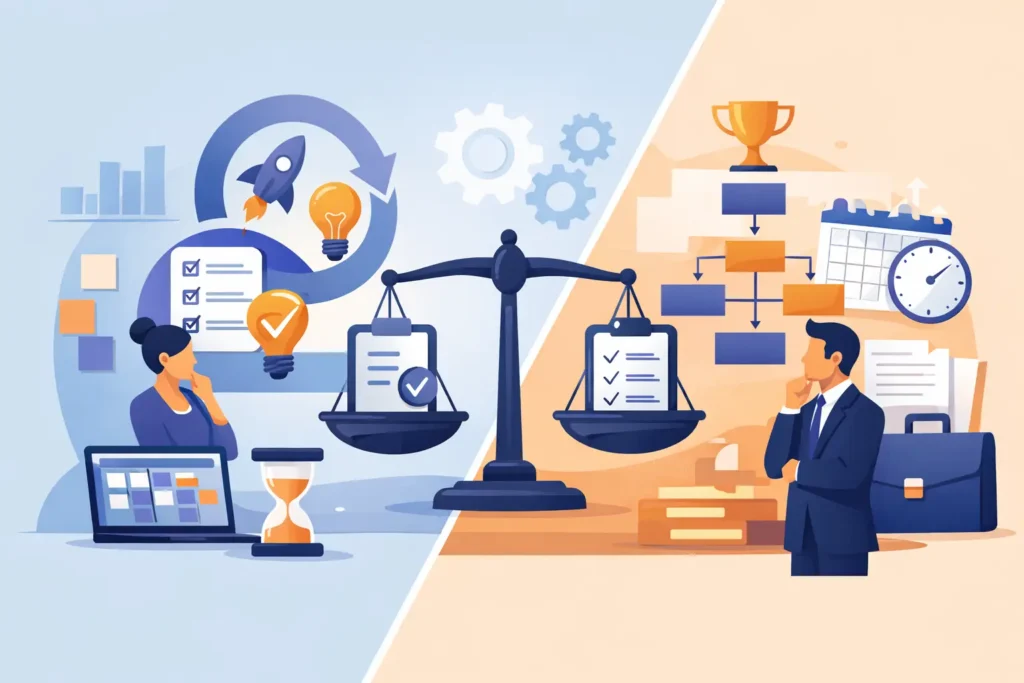
If you are deciding between pmi acp vs pmp, the real question is not which certification is better. It is which one fits your current role, your project environment, and the kind of jobs you want next. For many professionals, the wrong choice is not failing an exam. It is investing time and money in a credential that does not match how they actually work.
Both certifications come from PMI, and both carry strong market recognition. But they signal different strengths. PMP shows broad project leadership capability across predictive, agile, and hybrid delivery. PMI-ACP shows practical experience working in agile environments and a stronger focus on adaptive planning, team collaboration, and iterative delivery.
PMI-ACP vs PMP at a glance
PMP is the more established and widely requested certification across industries. It is often listed in job descriptions for project managers, senior coordinators, program leads, and professionals moving into leadership roles. If you work in construction, engineering, infrastructure, oil and gas, operations, or enterprise delivery, PMP usually has broader value.
PMI-ACP is more specialized. It is designed for professionals who already work in agile teams or in organizations that use Scrum, Kanban, Lean, or hybrid delivery models. It is highly relevant for IT, digital products, software, business transformation, and fast-moving cross-functional environments.
That distinction matters because employers read these certifications differently. PMP says you can lead projects with structure, governance, stakeholder control, and business alignment. PMI-ACP says you can operate effectively in adaptive delivery settings where change is frequent and planning evolves throughout the work.
What the PMP certification is really built for
PMP is not limited to traditional waterfall projects anymore. That is a common misunderstanding. The current exam includes predictive, agile, and hybrid approaches, which makes it far more relevant to modern project environments than many candidates assume.
What makes PMP powerful is scope. It tests whether you can lead people, manage delivery, and connect projects to business goals. The emphasis is broader than one methodology. You are expected to understand risk, stakeholders, team performance, planning, issue resolution, governance, and value delivery.
For professionals aiming at titles like Project Manager, Senior Project Engineer, Project Controls Lead, PMO role, or Delivery Manager, PMP often aligns more directly with career progression. It is especially useful if you want a credential that travels across sectors and is recognized by both technical and non-technical employers.
What PMI-ACP is really built for
PMI-ACP is narrower, but that does not make it smaller in value. It means the certification is more targeted. It validates agile thinking, agile team practices, and the ability to work in environments where priorities shift, customer feedback matters, and releases happen iteratively.
This certification is a strong fit if your daily work already includes backlog refinement, sprint planning, standups, retrospectives, adaptive prioritization, or continuous improvement practices. It can be especially useful for Scrum Masters, Agile Coaches, product-facing project professionals, business analysts in agile teams, and team leads involved in iterative delivery.
PMI-ACP tends to be strongest when paired with real agile exposure. If your experience is mostly schedule tracking, vendor coordination, reporting, and formal project control in fixed-scope environments, the certification may feel less aligned with your actual work.
Eligibility and experience requirements
One of the biggest practical differences in pmi acp vs pmp is eligibility. Before comparing prestige or salary impact, check whether you qualify.
PMP requires project management experience and formal project management education. The exact experience requirement depends on your education background. PMI also expects candidates to understand project leadership responsibilities, not just task participation.
PMI-ACP requires general project experience, agile project experience, and training in agile practices. In other words, PMI-ACP assumes you have not only worked on projects, but also spent meaningful time in agile settings.
For some candidates, this becomes the deciding factor. A professional with broad project experience in engineering or operations may qualify for PMP more naturally than PMI-ACP. A software delivery professional with sprint-based experience may find PMI-ACP more accessible and more relevant.
Exam content and difficulty
Neither exam is easy, but the challenge is different.
PMP is broader and more management-oriented. You need to think across people, process, and business context. Questions often test judgment. More than one option may look reasonable, and your task is to choose the best response based on PMI’s framework for project leadership.
PMI-ACP is more practice-centered within agile environments. The exam expects familiarity with agile principles, servant leadership, team dynamics, value-based prioritization, and iterative planning. If you have only memorized terms without working in agile teams, the exam can be difficult because it tests how agile thinking applies in real situations.
PMP often requires a larger preparation investment because the scope is wider. PMI-ACP can be more efficient to prepare for if you already live in an agile delivery model. That said, specialized does not mean easier. It simply means the exam rewards a different type of experience.
Career value and employer recognition
If your goal is maximum market recognition, PMP usually wins. It has stronger name recognition globally, broader cross-industry acceptance, and a long-standing reputation as the benchmark project management credential.
That matters in hiring. Recruiters, HR teams, and senior decision-makers often know PMP immediately, even outside highly mature project organizations. For professionals seeking promotions, role changes, or broader job mobility, that visibility has real value.
PMI-ACP has strong value too, but it tends to be more role-specific. In agile-focused organizations, it can carry serious weight. It shows that you understand agile beyond basic terminology and have worked in adaptive environments. But in industries where agile is not the dominant operating model, PMP may still carry more influence.
If you are choosing based on long-term flexibility, PMP generally gives you more room. If you are choosing based on direct relevance to your current agile role, PMI-ACP may be the smarter immediate move.
Which certification fits different professionals
If you are an engineer, construction professional, operations coordinator, project planner, or someone moving into formal project leadership, PMP is usually the stronger first certification. It matches structured delivery environments and supports advancement into recognized management roles.
If you work in software, digital transformation, product delivery, or a hybrid agile team, PMI-ACP may fit better. It validates the way your team already works and can strengthen your credibility in adaptive delivery settings.
If you are early in your career, the decision depends on your environment. Choosing PMP because it sounds bigger is not always the best move if your organization operates almost entirely through agile teams. Choosing PMI-ACP because agile is popular is also not the best move if your promotion path depends on broader project ownership and cross-functional leadership.
Should you get PMP first or PMI-ACP first?
For most professionals, PMP first is the safer sequence. It offers broader recognition, supports more career paths, and creates a strong foundation in project leadership. After that, PMI-ACP can add specialization if your work increasingly involves agile or hybrid delivery.
There are exceptions. If you are already embedded in agile delivery, applying for agile-focused roles, and your employer values iterative methods heavily, PMI-ACP first can make sense. It may give you faster relevance and a more direct return on effort.
The sequence should match your next 12 to 24 months, not just your long-term ambition. A certification is most valuable when it supports your immediate role progression.
Training matters more than most candidates expect
Many professionals underestimate the gap between reading exam content and being ready to pass. Both PMP and PMI-ACP require disciplined preparation, structured study, and realistic practice with scenario-based questions.
That is why training format matters. Working professionals usually need a schedule that fits around job commitments, along with instructor-led support that keeps preparation focused. A structured program can reduce wasted study time, clarify exam logic, and help you build confidence under exam conditions. For candidates comparing serious certification pathways, providers such as MMTI are often evaluated based on schedule flexibility, exam-focused delivery, and training credibility rather than course volume alone.
The better choice depends on your role, not the market noise
There is no universal winner in pmi acp vs pmp. There is only the credential that matches your work, your eligibility, and the roles you want to qualify for next. PMP is broader and more versatile. PMI-ACP is more targeted and agile-specific. Both are respected, but they solve different career problems.
If your work is centered on leading projects across teams, stakeholders, budgets, and delivery constraints, PMP is likely the better move. If your work is centered on agile execution, iterative planning, and team-based adaptive delivery, PMI-ACP may be the more accurate credential.
Choose the certification that makes your experience more credible in the eyes of the employer you want next. That is usually the decision that pays off fastest.