
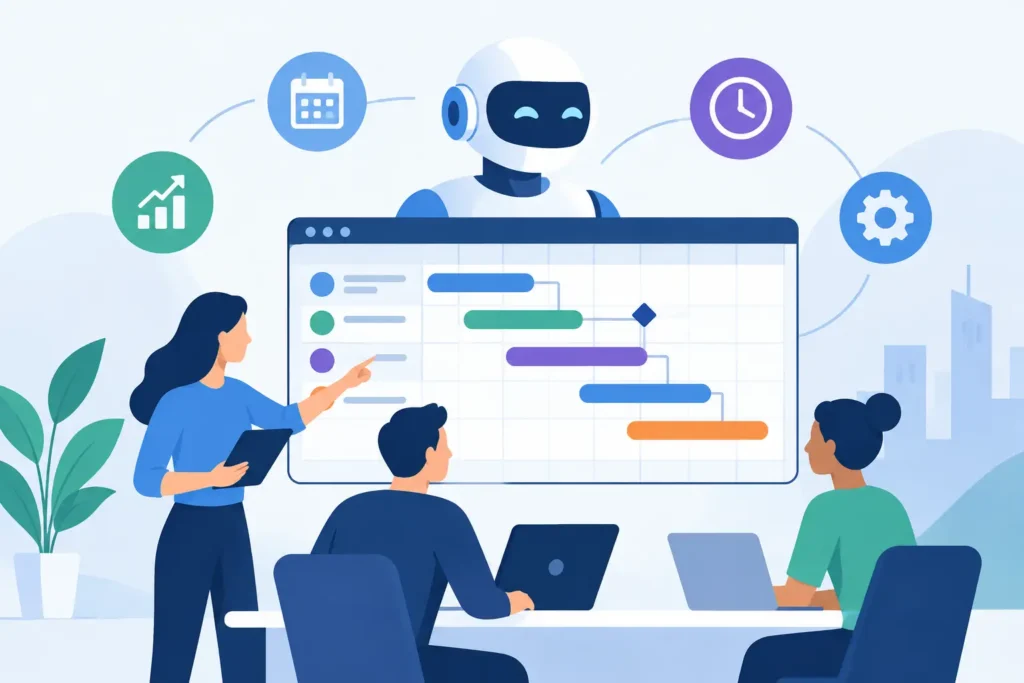
A project schedule can look credible on Monday and become irrelevant by Thursday. A delayed approval, unavailable specialist, late material delivery, or changed site condition can affect dozens of dependent activities. That is why AI scheduling trends are receiving serious attention from project managers, planners, engineers, and operations leaders. The value is not simply faster schedule creation. It is the ability to identify risk earlier, test alternatives quickly, and make better decisions before a small delay becomes a major recovery effort.
For professionals responsible for project delivery, the question is no longer whether artificial intelligence will appear in scheduling tools. It already has. The more practical question is where AI improves planning discipline, where it can create false confidence, and which capabilities project teams need to use it responsibly.
Why AI Scheduling Trends Matter to Project Professionals
Traditional scheduling remains essential. A well-built CPM schedule, supported by a clear work breakdown structure, realistic durations, logical relationships, resource assignments, and regular updates, is still the foundation of project control. AI does not remove the need for this work. It exposes weaknesses in it faster.
When schedule data is incomplete or poorly maintained, an AI-generated forecast may look precise without being reliable. If activity status is inaccurate, calendars are not aligned with actual working conditions, or dependencies are missing, the output cannot compensate for the planning gap. The familiar principle still applies: poor inputs produce poor decisions, even when the analysis is advanced.
Used correctly, AI can reduce the time spent searching for patterns across large schedules and performance records. This matters on construction, infrastructure, IT, and operational projects where planners must assess thousands of activities while coordinating with multiple stakeholders. Instead of replacing the planner, AI shifts more of the role toward validation, scenario analysis, stakeholder communication, and decision support.
The AI Scheduling Trends That Are Gaining Ground
Predictive delay forecasting
One of the most valuable applications is predicting the likelihood of schedule slippage before a milestone is missed. AI models can review historical performance, progress updates, productivity trends, weather exposure, procurement data, issue logs, and resource availability to identify activities with a higher probability of delay.
A useful forecast does not merely state that a project is at risk. It should help the team understand why. For example, a critical installation activity may appear on track by planned dates, but the model may recognize a repeated pattern: submittal approvals have taken longer than expected, required labor is already committed elsewhere, and predecessor work has a low completion confidence level. That insight gives the project manager a reason to intervene early.
The trade-off is transparency. Project leaders should be able to challenge the assumptions behind a risk score. If a tool cannot explain the drivers of its prediction in practical terms, it should not become the sole basis for a schedule recovery decision.
Automated schedule quality checks
Schedule quality reviews often require planners to inspect logic, constraints, lags, float values, open ends, and unusual duration patterns. AI-assisted checks can flag concerns quickly, especially on large integrated schedules. This can improve the consistency of monthly updates and reduce the risk of reporting a schedule that appears healthy but contains weak logic.
Automation is particularly helpful for routine review tasks, such as identifying activities with no predecessors or successors, excessive hard constraints, negative float, or late data dates. It can also highlight changes between updates that deserve management attention.
However, a flagged item is not automatically an error. A long-duration procurement activity, for example, may be appropriate when it represents a controlled package with clear internal milestones. The scheduler must understand the project context before changing the plan. AI can prioritize the review; experienced professionals still make the judgment.
Faster what-if scenario planning
When a major risk occurs, teams need answers quickly. What happens if a key vendor delivers two weeks late? Can overtime recover the schedule? Which work areas can be resequenced? What is the cost and risk of accelerating a critical activity?
AI-supported scenario planning can evaluate more options in less time than a fully manual exercise. This is useful when project controls teams are under pressure to prepare alternatives for leadership meetings. Rather than working through one possible recovery plan, planners can compare several options based on schedule impact, resource demand, cost exposure, and delivery risk.
The best result is not always the shortest schedule. A recovery action that protects a completion date but overloads a specialist team, increases safety exposure, or creates a procurement bottleneck may introduce a larger problem later. Decision-makers need the scenario analysis, but they also need the operational context behind it.
Resource and capacity intelligence
Resource constraints frequently cause schedule problems that are not visible in a simple activity network. A project may have logical float on paper while relying on the same engineers, supervisors, equipment, or approval authorities across several concurrent workstreams.
AI can help identify resource conflicts, forecast capacity gaps, and suggest alternatives based on patterns in labor utilization and task performance. For portfolio leaders, this can improve decisions about which projects to prioritize and when to launch new work.
This capability depends heavily on data discipline. Many organizations have schedule data in one system, timesheets in another, procurement status in spreadsheets, and workforce availability managed informally. Before expecting meaningful resource intelligence, teams need consistent definitions, timely updates, and accountable data ownership.
Natural-language project reporting
Another developing use case is the conversion of schedule data into clear management narratives. Instead of manually drafting every weekly report, teams can use AI to prepare a first version that identifies key milestone movement, critical path changes, overdue activities, and major risks.
This can save time, but the final report requires review. Senior stakeholders need concise, accurate reporting that distinguishes a current issue from a forecast risk and explains the required decision. Generic text can make a report sound polished while hiding the real project condition. The project manager should remain accountable for the message.
What AI Cannot Replace in Scheduling
A schedule is more than a mathematical model. It reflects contractual obligations, construction methodology, stakeholder priorities, local constraints, commercial decisions, and the experience of the people delivering the work. AI cannot independently negotiate a recovery plan with a subcontractor, validate field productivity through a site walk, or determine whether a proposed acceleration method is safe and practical.
It also cannot resolve ambiguity when the project team has not agreed on scope, acceptance criteria, or ownership. In those situations, better technology may produce faster analysis, but it cannot substitute for governance.
The strongest project environments will combine AI support with established scheduling practices: defined baselines, disciplined progress measurement, change control, risk management, resource planning, and regular schedule reviews. Professionals who understand these fundamentals will be better positioned to evaluate AI outputs rather than accept them without question.
How to Prepare for AI-Enabled Scheduling
Project professionals do not need to become data scientists to benefit from AI scheduling tools. They do need stronger control over the information that feeds the schedule. Start with the basics: build logic-driven schedules, use realistic calendars, keep activity updates current, document assumptions, and align progress reporting with actual work completed.
Next, develop the ability to ask better questions. Rather than asking an AI tool whether the project will finish on time, ask which activities are driving the forecast, what assumptions are behind the prediction, which data points are missing, and what recovery options create the least operational risk. These questions turn an automated output into a useful management discussion.
Formal training remains valuable here. Credentials such as PMP, PMI-SP, Primavera P6, and Microsoft Project training build the planning, scheduling, and controls knowledge needed to use new tools intelligently. For working professionals, a structured course can also provide the practical framework to connect technology with established project management standards.
Organizations should introduce AI in controlled stages. A sensible first step may be using it for schedule health checks or report drafting, where outputs can be reviewed against current processes. As confidence and data quality improve, teams can expand into forecasting and scenario analysis. This approach limits risk while helping the organization learn where the technology delivers measurable value.
The Real Advantage Is Better Project Judgment
AI will make schedule analysis faster, but speed alone does not improve project outcomes. The advantage comes when project teams use that time to investigate root causes, challenge weak assumptions, communicate risk earlier, and make decisions before critical milestones are threatened.
For career-focused project professionals, this creates a clear opportunity. The most valuable schedulers and project managers will not be those who rely entirely on automation or resist it completely. They will be the professionals who can combine credible scheduling methods, recognized credentials, and sound judgment to turn data into action when the project needs it most.